What Is Earnest Money and How Much Should Lake Nona Sellers Expect?
What Is Earnest Money and How Much Should Lake Nona Sellers Expect?
You accepted an offer. The buyer says they are serious. But here is the question you should be asking: what are they actually putting on the line?
That is exactly what earnest money tells you. It is one of the most important signals in a real estate transaction, and if you are selling a home in Lake Nona, understanding it will help you evaluate offers more clearly and protect yourself when things get complicated.
What Is Earnest Money?
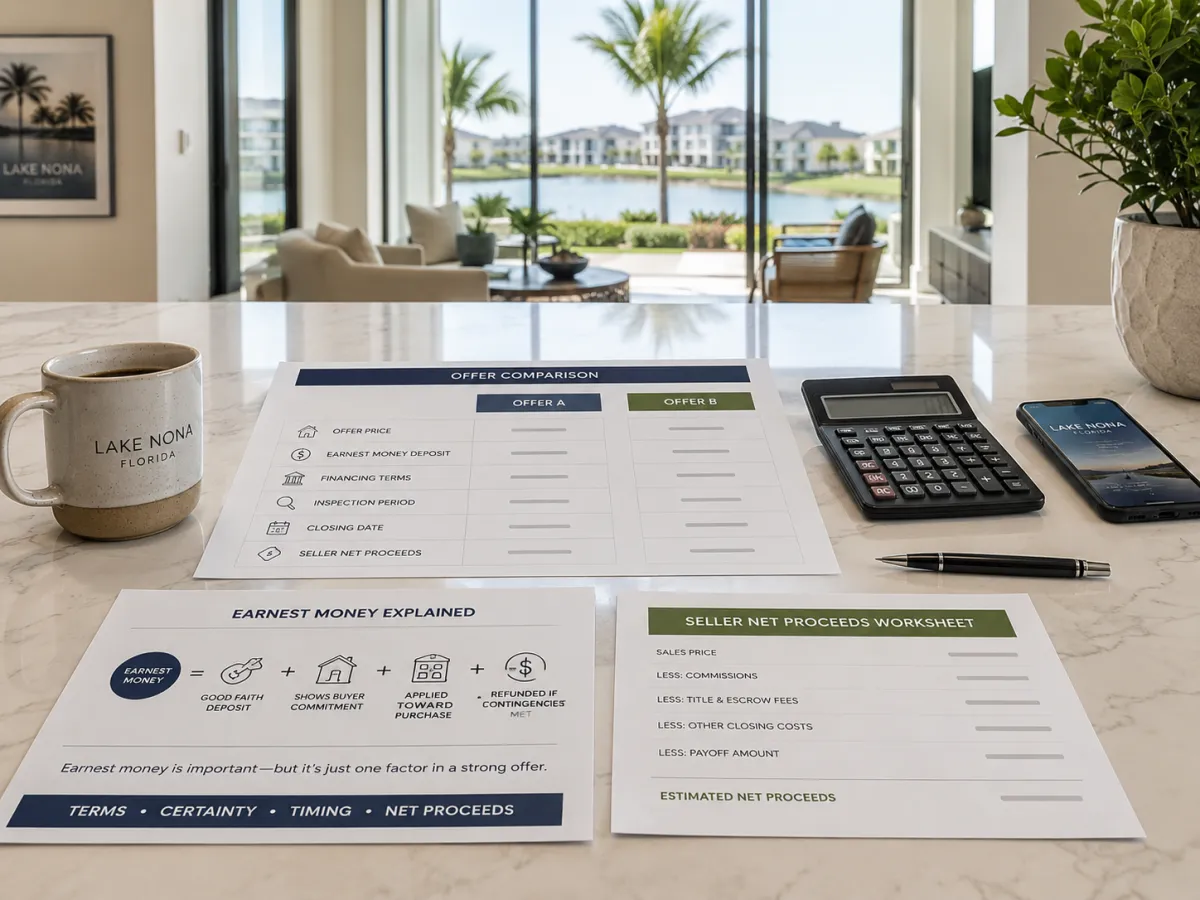
Earnest money is a good-faith deposit a buyer submits when making an offer to purchase a home. The purpose is simple: to demonstrate that the buyer is serious and financially committed to following through.
Think of it as the buyer putting real money where their words are. Anyone can write an offer. Earnest money means the buyer has real skin in the game.
The deposit is not paid directly to you as the seller. It is held in escrow by a neutral third party, typically a title company or real estate attorney, until the transaction closes or until the parties agree on how to handle it if the deal falls apart.
How Much Earnest Money Should You Expect in Lake Nona?
There is no fixed legal requirement for earnest money amount in Florida. The amount is negotiated as part of the purchase contract. In the Lake Nona market, you will commonly see deposits in the range of 1% to 3% of the purchase price.
Here is what that looks like on a real number: With the Lake Nona area median sold price at $829,800 as of June 2026, a 1% deposit would be roughly $8,300. A 3% deposit would be approximately $24,900. On higher-end homes in communities like Eagle Creek, VillageWalk, or Lake Nona Golf and Country Club, the actual dollar amount of the deposit is correspondingly larger.
A larger deposit is generally a positive signal. It does not guarantee the deal will close, but it shows the buyer has access to real capital and has thought seriously about their commitment.
That said, a smaller deposit is not automatically a red flag. A strong cash buyer who works with a reputable agent and presents a clean offer may deposit less. Context matters. You want to look at the full picture, not any single data point.
When Do You Keep the Earnest Money?
This is the question sellers care most about. The answer depends on why the buyer is walking away.
When the Seller Can Keep It
If a buyer defaults on the contract without a valid contingency reason, the seller can typically pursue the earnest money as a remedy for buyer default under the Florida Realtors purchase contract. This is sometimes called liquidated damages.
In practical terms, this means if a buyer simply changes their mind, decides they found something they like better, or fails to perform without invoking a contract contingency, you have grounds to claim the deposit.
When the Buyer Gets It Back
If the buyer exercises a valid contingency, they are generally entitled to a refund of their earnest money. Common contingencies include:
- Inspection contingency if the buyer elects to cancel within the inspection period
- Financing contingency if the buyer's loan is denied despite genuine good-faith efforts to obtain financing
- Appraisal contingency if the home appraises below the purchase price and the parties cannot agree on a resolution
- Home sale contingency if the contract included a condition on the buyer selling their current home first
It is important to understand that earnest money disputes can be complicated. Florida law requires the escrow holder to get written agreement from both parties before releasing disputed funds, or to seek court direction. Disputes over earnest money are not resolved overnight.
What I tell sellers: Earnest money is a signal, not a guarantee. A serious buyer puts up a meaningful deposit and works through the process in good faith. If something feels off in how an offer is structured, talk to your agent before you accept. The deposit amount is one of several things we look at when helping you evaluate whether an offer is truly strong.
What Happens to the Earnest Money at Closing?
Here is something sellers sometimes do not realize: you do not receive the earnest money separately from the sale proceeds. At closing, the earnest money is applied toward the buyer's closing costs or down payment. It reduces the amount the buyer needs to bring to the closing table.
As the seller, your proceeds come from the total purchase price minus your costs, not from the earnest money specifically. The deposit was never in your hands to begin with. What you receive at closing is the net proceeds from the sale.
Tips for Evaluating Earnest Money as a Seller
When you are reviewing offers, here is how to think about the deposit in context:
- Higher deposit signals more commitment. A buyer putting up $20,000 is more committed than one putting up $1,000 on the same price home.
- Look at the contingency structure. A large deposit paired with long, open-ended contingencies can still leave you exposed. Look at the whole offer, not just the deposit line.
- Cash buyers often deposit less. Because they do not have a financing contingency risk, cash buyers may offer a smaller deposit. That is usually fine.
- Ask about the deposit timeline. The Florida Realtors contract specifies how many days the buyer has to deliver the deposit after the effective date. A shorter timeline and prompt delivery are good signs.
Related Articles for Lake Nona Sellers
- How to Negotiate Offers on Your Lake Nona Home
- Is the Highest Offer Always the Best Offer in Lake Nona?
- What Contingencies Should Lake Nona Sellers Watch Out For?
- How to Handle Multiple Offers on Your Lake Nona Home
- What Happens After You Accept an Offer on Your Lake Nona Home?
Frequently Asked Questions
What is earnest money in a real estate transaction?
Earnest money is a good-faith deposit submitted by the buyer when making an offer. It signals buyer seriousness and is held in escrow by a neutral third party, typically a title company or real estate attorney, until closing or until the parties resolve any dispute.
How much earnest money should a Lake Nona seller expect?
Earnest money is negotiable and not fixed by law in Florida. In Lake Nona, deposits commonly range from 1% to 3% of the purchase price. With the June 2026 area median at $829,800, that translates to roughly $8,300 to $24,900. Higher-end homes in communities like Eagle Creek or Lake Nona Golf and Country Club see correspondingly larger deposits.
When can a seller keep the earnest money?
A seller can typically keep the deposit if the buyer defaults on the contract without invoking a valid contingency. If a buyer walks away due to a valid contingency, such as a failed inspection they elected to cancel under, or a denied loan, the deposit is generally returned to the buyer. Earnest money disputes in Florida require written agreement from both parties or a court ruling to resolve.
Who holds earnest money in Florida?
In Florida, earnest money is held in escrow by a neutral third party named in the contract, typically the title company, a real estate attorney, or sometimes the listing brokerage's escrow account. Funds remain in escrow until closing or until both parties agree on disbursement if the deal falls apart.
Does earnest money come to the seller at closing?
No. At closing, earnest money is applied toward the buyer's costs or down payment, reducing what they need to bring to the table. The seller receives net proceeds from the total purchase price, not the deposit specifically. The deposit was always in escrow and was not held by the seller.
Have questions about evaluating offers on your Lake Nona home? Let's talk through your specific situation and build a strategy that protects your interests.
Get a Free Seller Strategy Session